
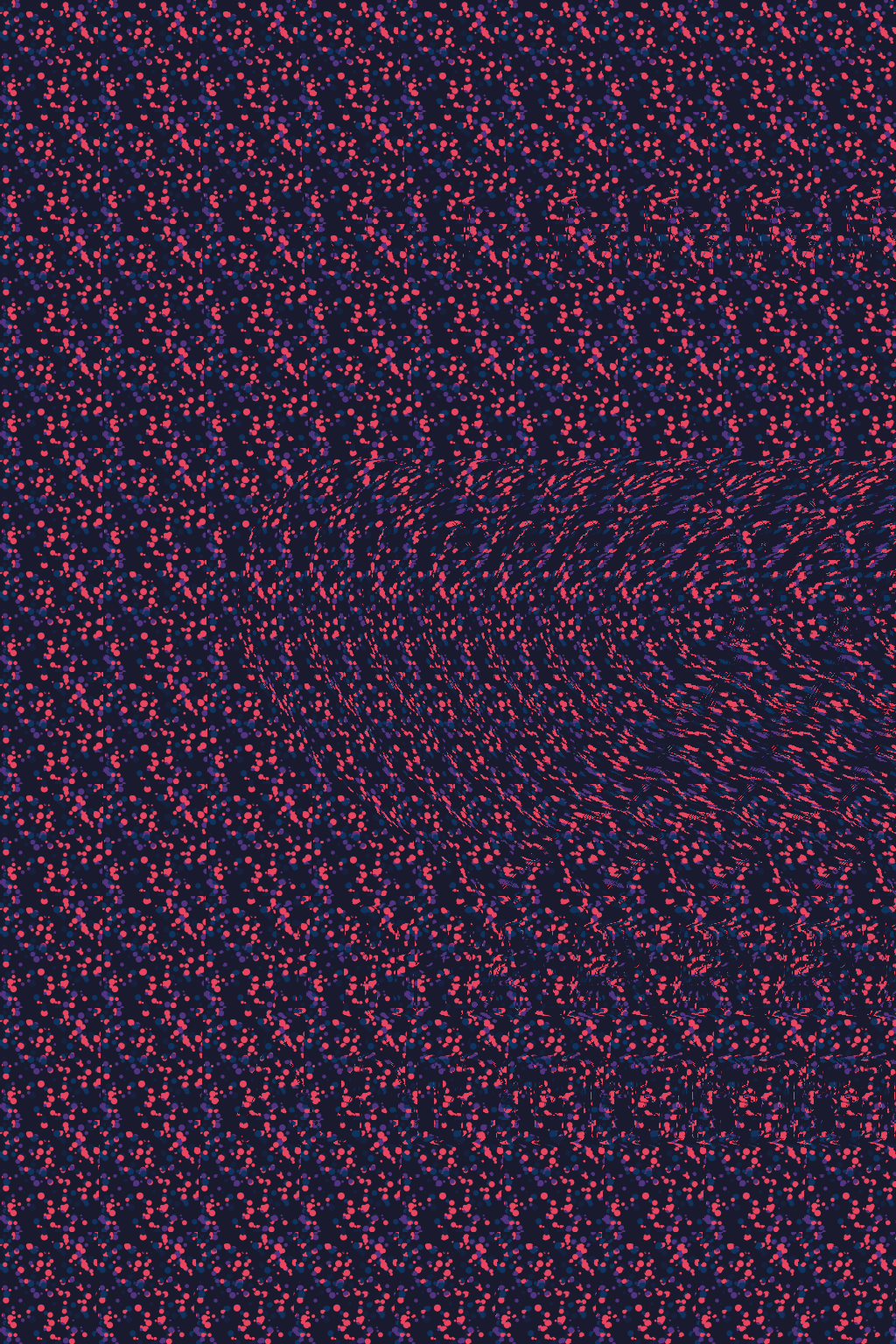
Three Steps to Magic
Upload Your Image
Drop any photo — portraits, landscapes, objects. Our AI handles the rest.
AI Estimates Depth
Depth Anything V2 runs in your browser to create a 3D depth map. Preview it in interactive Three.js.
Generate & Download
Pick a pattern, generate your autostereogram, and download or share it.
Built for Wonder
Client-Side AI
Depth estimation runs entirely in your browser. Zero server cost, full privacy.
3D Preview
Interactive Three.js visualization lets you explore depth before generating.
Share & Gallery
Save your creations and build a gallery of Magic Eye images.
Multiple Patterns
Choose from cosmic dots, geometric tiles, noise, waves, and more.
What is a Magic Eye?
A Magic Eye is an autostereogram — a flat 2D image that hides a 3D shape inside a repeating pattern. When you relax your eyes and look “through” the image, a hidden three-dimensional scene pops out.
They were a cultural phenomenon in the 1990s. The first Magic Eye book hit #1 on the New York Times bestseller list in 1993 and stayed there for 14 weeks. Over 20 million copies were sold. They were everywhere — mall kiosks, newspaper columns, even a famous Seinfeld episode.
The science goes back to 1838, when Charles Wheatstone discovered stereoscopy. In 1979, Christopher Tyler created the first single-image stereogram. And now, AI makes it possible for anyone to create one from any photo.
Charles Wheatstone discovers stereoscopy
Béla Julesz creates random-dot stereograms at Bell Labs
Christopher Tyler invents the single-image autostereogram
Magic Eye books sell 20M+ copies, #1 NYT bestseller
Peak mania — Seinfeld, Oprah, every mall in America
AI depth estimation lets anyone create Magic Eyes instantly
How to See the 3D
It takes a little practice, but once you see it, you'll never forget how.
Get Close
Hold the image right up to your nose or bring your face close to the screen.
Relax Your Eyes
Let your eyes unfocus, as if looking through the image at something far away.
Pull Back Slowly
Very slowly move the image away. Keep your eyes relaxed — don't rush.
See the 3D
A 3D shape will emerge from the pattern. Once it clicks, it gets easier every time.
Watch a Video Tutorial
90s Nostalgia, Modern AI
What once required 3D modeling software and deep technical knowledge now happens in your browser in seconds.
AI Depth Estimation
Depth Anything V2, a 24.8M-parameter neural network, analyzes any photograph and predicts the depth of every pixel — running entirely in your browser via WebGPU.
Browser-Native ML
Powered by Hugging Face Transformers.js and WebGPU, the AI runs at near-native speed on your device. No server, no upload, no waiting — complete privacy.
Interactive 3D Preview
Before generating, explore the AI depth map as a 3D surface with Three.js. Orbit, zoom, and inspect the depth — something 90s creators could only dream of.